
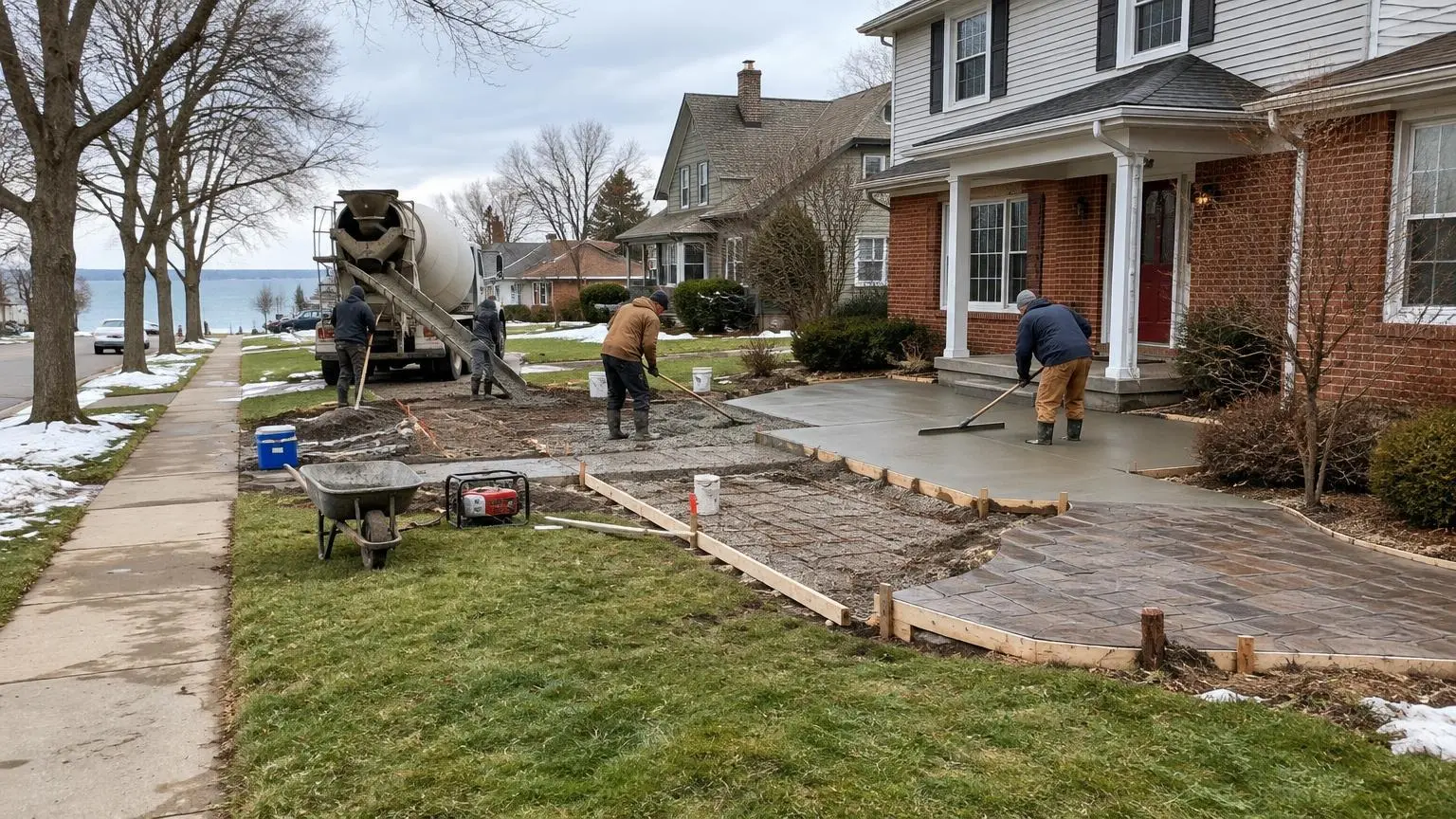
Replacement, widening and new aprons
Concrete Driveways in Kenosha, WI
Built to shed meltwater, carry your heaviest vehicle and shrug off plow blades and road salt.
- A site visit and measurements before any price
- Line-item estimate: base, thickness, steel, finish and sealer
- Air-entrained mix and sawn joints on every outdoor slab
A Concrete Driveway That Survives the Salt
No slab on your property works harder than the driveway. Every car and delivery van rolls over it, it is scraped and salted from December to March, and snowmelt that runs onto it in the afternoon turns to ice by morning. When we replace concrete driveways in Kenosha, we build them for that job: a compacted stone base, the right thickness, an air-entrained mix and joints that control where it cracks.
Why old Kenosha driveways fail
Most driveway failures start underneath. When the stone layer was skimpy or the soil was left loose, water pools beneath the concrete, freezes, jacks the slab up and lets it sag again at the spring thaw. Sections tilt, joints open up and edges break off. On top, a surface that was finished wet or never sealed starts to scale once salt gets into it. Older homes often have a driveway that has been patched, overlaid or partly replaced over the decades, with each piece moving on its own. At that point a full tear-out costs less over time than chasing repairs.
Signs it is time to replace
- Cracks wider than a pencil, or cracks that keep growing each spring
- Slabs that have sunk, tilted toward the house or lifted at the garage
- Flaking, pitting or a rough surface where the top layer has come off
- Water that pools in the same spot and freezes into ice sheets
- Broken edges along the lawn or the street apron
- A drive that no longer fits the cars and trucks you own today
Thickness and reinforcement
Per HomeGuide's driveway guide, passenger cars need a minimum of 4 inches, RVs and other heavy vehicles 5 to 6, and edges should be thickened to 6 to 8. We look at what you park, whether trucks or trailers use the drive, and where the slab meets the street. Rebar adds strength across joints and soft spots. HomeGuide puts steel at $1 to $3 per square foot, money we usually advise spending on a replacement drive.
Drainage and slope
A driveway should shed water away from the garage and the house. We set forms so the slab has enough fall to drain, check where downspouts empty, and avoid creating a low spot where meltwater sits and turns to ice. Where a driveway runs close beside the house, this matters even more.
Finish options
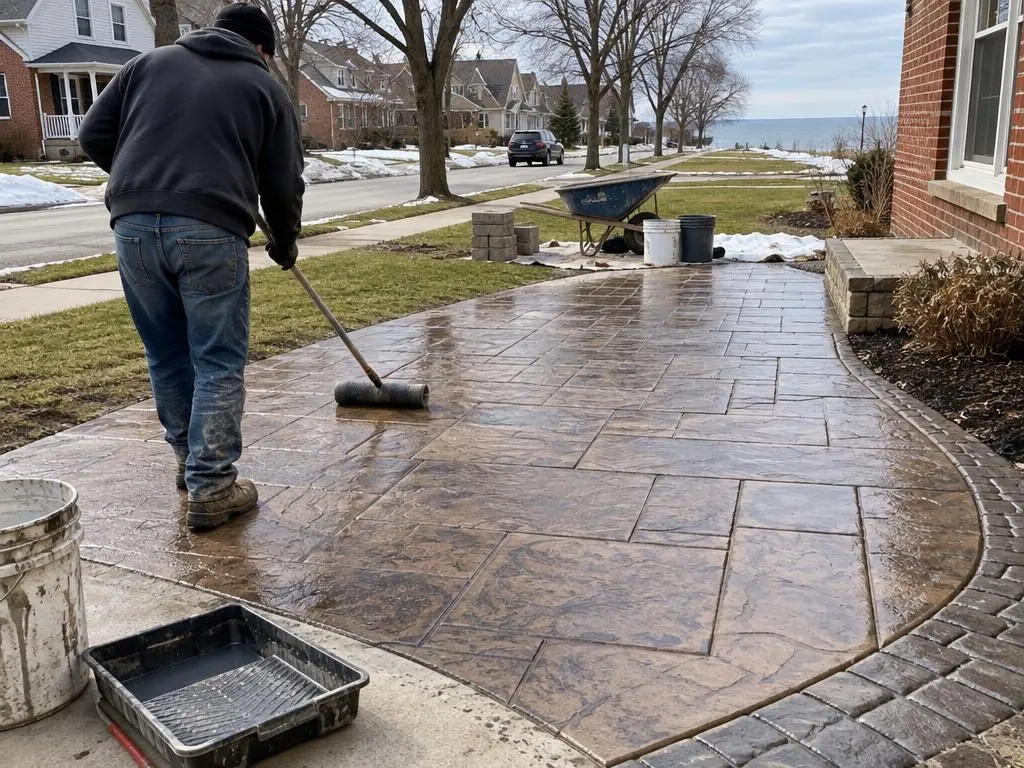
Most Kenosha driveways get a broom finish. Those fine ridges help tires and boots hold on a frosty morning. Exposed aggregate leaves the stone visible and disguises tire scuffs. Stamped borders or a stamped apron add a decorative edge. Smooth troweled finishes look clean but get slick, so we do not recommend them for a driveway in this climate.
Caring for a new driveway
Keep cars off for at least 7 days, as HomeGuide advises, and keep heavy trucks off for about a month. Do not use de-icing salt during the first winter. Use sand for traction instead. HomeGuide recommends the first seal after 28 to 30 days of curing and resealing every 2 to 3 years. Clear snow with a plastic-edged shovel when you can, and keep downspouts pointed away from the slab.
What a Driveway Replacement Includes
Your driveway estimate breaks out each of these, so every dollar has a label.
Tear-out and haul-away
Old concrete or asphalt broken up, loaded and removed, including buried patches and old overlays.
Base preparation
Soft soil dug out, then a stone base placed and compacted so water drains and the slab has firm support.
Forms and grade
Forms set for width, slope and a clean edge, with fall away from the garage and house.
Reinforcement
Rebar or mesh placed where the slab needs it, with thickened edges and apron where vehicles turn.
Pour, finish and joints
Air-entrained concrete placed, broom finished and jointed so cracks form in straight lines.
Aprons and widening
New street aprons, parking pads or extra width added to fit more vehicles.
Typical Concrete Driveway Costs
| Item | Published range |
|---|---|
| Plain concrete driveway, per sq ft installed | $6 to $15 |
| One-car, 12' x 24' (288 sq ft) | $1,700 to $4,300 |
| Two-car, 20' x 20' (400 sq ft) | $2,400 to $6,000 |
| Two-car, 24' x 24' (576 sq ft) | $3,500 to $8,600 |
| Three-car, 24' x 36' (864 sq ft) | $5,200 to $13,000 |
| Old driveway removal, per sq ft | $2 to $6 |
| Rebar, per sq ft | $1 to $3 |
| Sealing, per sq ft | $1 to $3 |
National ranges from HomeGuide's concrete driveway cost guide. Kenosha prices can differ. Removal, access, thickness, reinforcement and finish all change the total. Your written estimate is the price.
How We Replace a Driveway
1. Measure and plan
We measure, check slope and drainage, note what you park and check permit needs for the apron.
2. Remove and prepare
We break out the old slab, excavate anything soft and compact fresh stone in its place.
3. Form and pour
With forms and steel set, the air-entrained mix is poured, broomed and sawn into panels.
4. Cure and hand over
While it cures you get three dates: first footsteps, first car, first sealer.
Concrete Driveways Questions
How thick should a driveway be in Kenosha?
HomeGuide's minimum is 4 inches under cars, 5 to 6 under RVs and heavy trucks, with the edges built up. We often go thicker at the apron, where plows and turning tires load the edge.
Can you pour over my old driveway?
We rarely recommend it. A new layer follows the cracks and movement of the old slab and raises the height at the garage. Taking it out is how we get at the base, and the base is usually what failed.
How long before I can park on it?
Give it a full week before a car goes on it and roughly a month before anything heavy, per HomeGuide. Walking on it is generally fine after a day or two.
Should I seal a new concrete driveway?
Yes. Sealer slows how fast water and salt soak into the surface. HomeGuide says to apply the first coat after 28 to 30 days and to reseal every 2 to 3 years.
Is concrete or asphalt better for a driveway here?
Concrete costs more up front and lasts longer with less upkeep. Asphalt is cheaper but needs sealing and patching more often. Concrete is all we install, and if your situation points to asphalt we will say so.
Concrete Driveways Service Areas
- Concrete Contractors in Kenosha, WI
- Concrete Contractors in Pleasant Prairie, WI
- Concrete Contractors in Somers, WI
- Concrete Contractors in Bristol, WI
- Concrete Contractors in Paddock Lake, WI
- Concrete Contractors in Salem Lakes, WI
- Concrete Contractors in Twin Lakes, WI
- Concrete Contractors in Racine, WI
- Concrete Contractors in Mount Pleasant, WI
- Concrete Contractors in Sturtevant, WI
- Concrete Contractors in Caledonia, WI
- Concrete Contractors in Union Grove, WI
- Concrete Contractors in Wind Point, WI
- Concrete Contractors in Zion, IL
- Concrete Contractors in Winthrop Harbor, IL
- Concrete Contractors in Beach Park, IL
- Concrete Contractors in Waukegan, IL
- Concrete Contractors in Gurnee, IL
- Concrete Contractors in Wadsworth, IL
- Concrete Contractors in Antioch, IL
- Concrete Contractors in Lindenhurst, IL
- Concrete Contractors in Lake Villa, IL
Get a Concrete Driveways Estimate
Send rough dimensions and a note on what is failing. We will measure and send a written price.