
Settled as Port Gilbert in 1834
Concrete Contractors in Racine, WI
Concrete for a dense lakefront city with older homes, tight lots and plenty of front steps.
- A site visit and measurements before any price
- Line-item estimate: base, thickness, steel, finish and sealer
- Air-entrained mix and sawn joints on every outdoor slab
Racine Concrete: Older City, Tight Spaces
Racine is a dense, older city, and concrete contractors here spend a lot of time on replacements rather than new pours. The city counted 77,816 residents in 2020 on just 15.47 square miles of land, which is more than 5,000 people per square mile. Its 33,871 housing units sit close together, and many of them have narrow driveways, alley garages and front steps rising from the sidewalk.
A long building history
Gilbert Knapp settled the area as Port Gilbert in 1834. Racine became a village in 1841 and a city in 1848. It grew as an industrial center, home to J. I. Case, Horlicks and S. C. Johnson & Son, whose 1936 headquarters was designed by Frank Lloyd Wright. The city has historic districts, including Old Main Street and the Southside Historic District.
A city with that much history has concrete of every age. Some walks and steps here have been patched for decades. Some garage slabs were poured long before anyone used air entrainment or a stone base.
Common Racine jobs
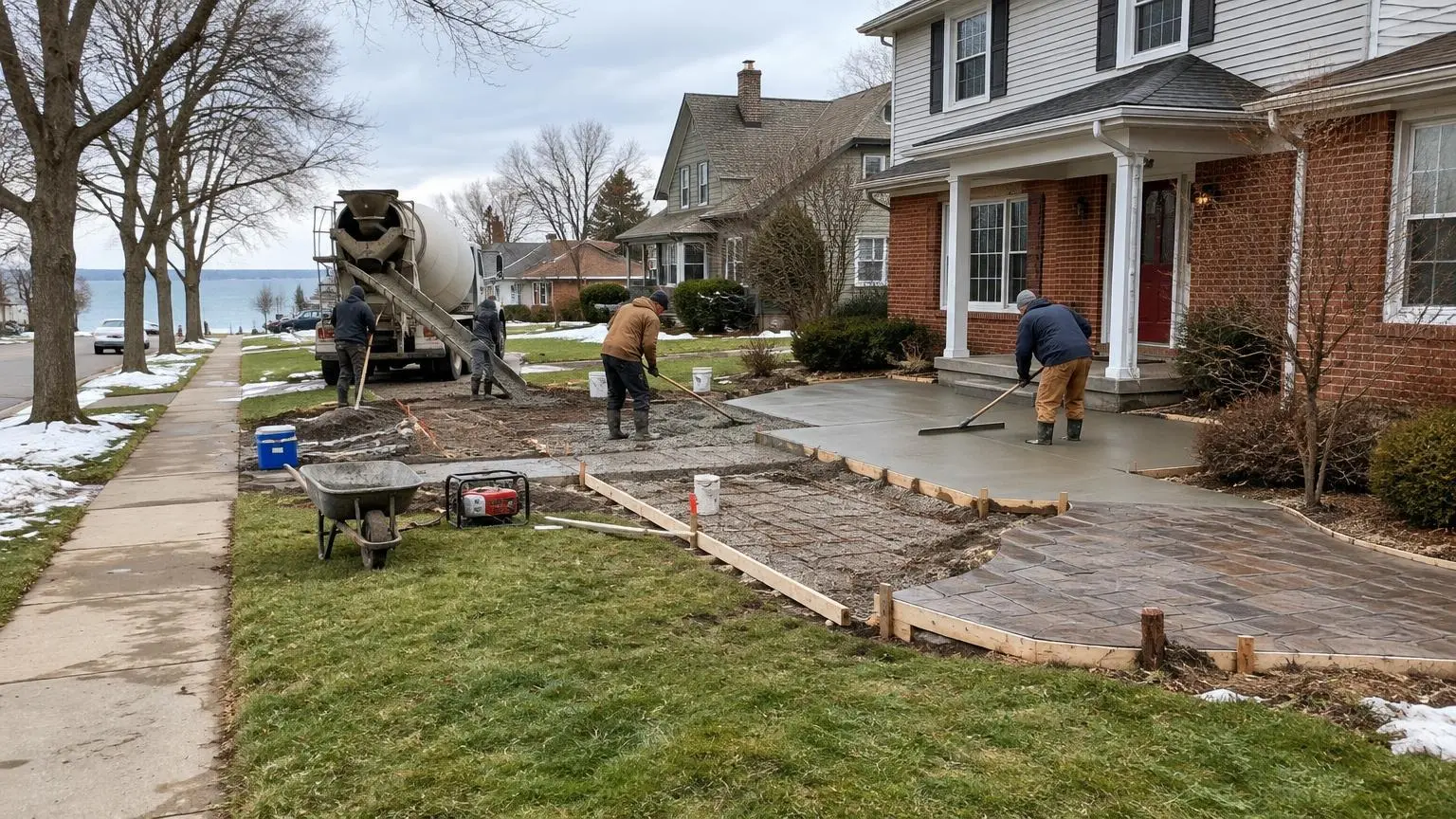
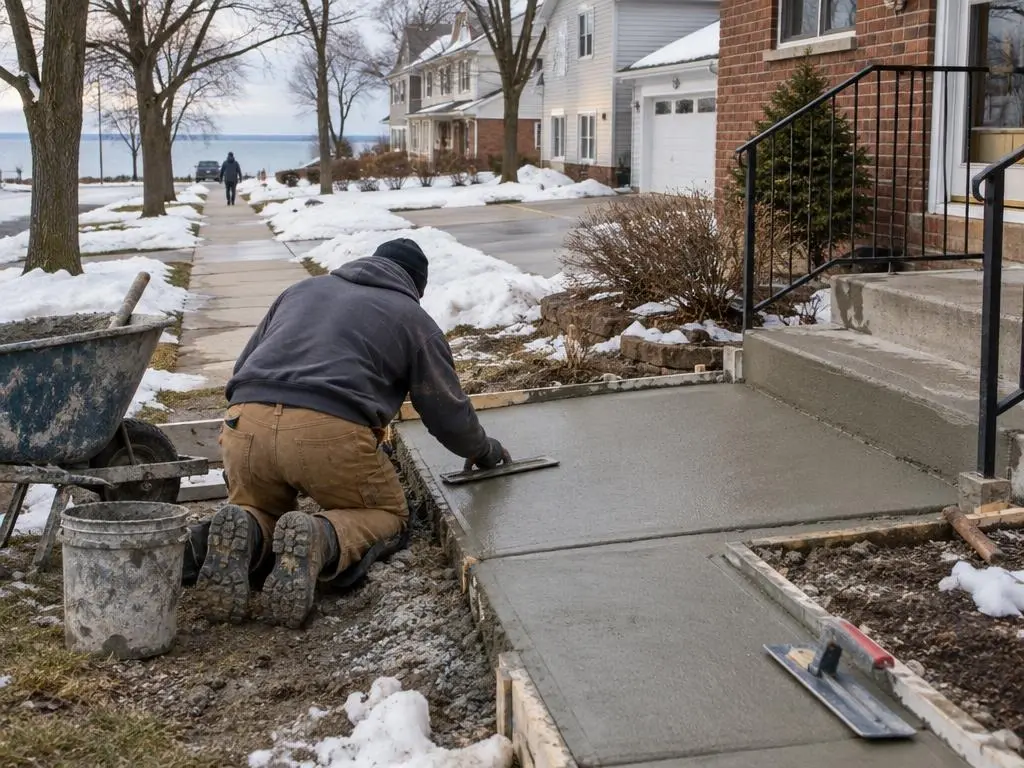
1. Front steps and stoops. Many homes sit a few feet above the sidewalk. Old steps crack, tilt and pull away from the house. We remove them and pour new steps with even rises and a solid footing. 2. Narrow driveway replacement. We plan tear-out and pours in tight spaces next to the house and the neighbor's lot line. 3. Alley and detached garage slabs. Old garage floors often crack and sink. We can replace the slab, sometimes with the garage still standing, or pour a new one for a rebuild. 4. Walks and side yards between closely spaced homes. 5. Small backyard patios, including stamped concrete for a finished look in a small space.
Lake weather, salt and snow
Racine sits on Lake Michigan at the mouth of the Root River. Climate normals for the city list about 41 inches of snow a year, with most of it in January and February, and a mean January low of 14.5°F. That means a long season of freezing and thawing and a lot of road salt. Salt and freeze-thaw together cause the flaking and scaling you see on many older Racine steps and drives.
We use air-entrained concrete for all outdoor work, finish and cure it properly, and recommend sealing. We also tell you which deicers to avoid on new concrete.
What pour day looks like on a tight lot
On a Racine lot, pour day takes planning. Here is how it usually goes: 1. Tear-out. We break out the old concrete and haul it away. On a narrow drive, we may use smaller equipment. 2. Base. We remove soft soil, add stone and compact it. This is the step most old slabs skipped. 3. Forms and steel. Forms set the shape and slope. Reinforcement goes in on supports. 4. The pour. The truck parks on the street or in the alley. If it cannot reach, we use a pump or wheelbarrows. 5. Finish. We screed, float and finish the surface, then broom or stamp it. 6. Joints and curing. We cut joints and apply a curing method.
We let neighbors know when the truck is coming when the job is close to their property, and we clean the street and sidewalk when we leave.
Small projects count too
In a dense city, many jobs are small: one section of walk, a single stoop, a pad for trash cans by the alley, or a short apron. We take those on with the same care as a full driveway, and the same written estimate.
Before we start
Work that touches the public sidewalk or the apron at the street may need city approval. We check whether the City of Racine requires a permit for your address before scheduling. In a dense city, we also plan where the truck will park and how we will protect your neighbor's property during the pour.
Racine by the Numbers
- Density. Racine had 77,816 residents in 2020 on 15.47 square miles of land, over 5,000 people per square mile.
- Founding. The area was settled as Port Gilbert in 1834; Racine became a city in 1848.
- Snowfall. Climate normals list about 41 inches of snow a year, with a mean January low of 14.5°F.
- Historic districts. Racine's historic districts include Old Main Street and the Southside Historic District.
Racine Questions
Can you replace front steps on an older Racine home?
Yes. We remove the old steps, pour a proper footing and form new steps with even rises and a non-slip finish.
Can you replace a garage floor without tearing down the garage?
Often, yes. We break out the old slab, rebuild the base and pour new concrete inside the existing walls when the structure allows it.
Why is my Racine driveway flaking?
Freeze-thaw cycles and road salt cause surface scaling, especially on older concrete without air entrainment. Replacement with air-entrained concrete and sealing helps.
Free Estimates in Racine, WI
Get a free written estimate for concrete at your Racine home.
Concrete Contractors Near Racine
- Concrete Contractors in Kenosha, WI
- Concrete Contractors in Pleasant Prairie, WI
- Concrete Contractors in Somers, WI
- Concrete Contractors in Bristol, WI
- Concrete Contractors in Paddock Lake, WI
- Concrete Contractors in Salem Lakes, WI
- Concrete Contractors in Twin Lakes, WI
- Concrete Contractors in Mount Pleasant, WI
- Concrete Contractors in Sturtevant, WI
- Concrete Contractors in Caledonia, WI
- Concrete Contractors in Union Grove, WI
- Concrete Contractors in Wind Point, WI
- Concrete Contractors in Zion, IL
- Concrete Contractors in Winthrop Harbor, IL
- Concrete Contractors in Beach Park, IL
- Concrete Contractors in Waukegan, IL
- Concrete Contractors in Gurnee, IL
- Concrete Contractors in Wadsworth, IL
- Concrete Contractors in Antioch, IL
- Concrete Contractors in Lindenhurst, IL
- Concrete Contractors in Lake Villa, IL